

Most affiliate marketers don’t fail because they picked the wrong niche or promoted the wrong offer. They fail because they run the business in bursts, a flurry of activity for two weeks, then silence for a month. Then they wonder why the income never smooths out.
The marketers who actually build a repeatable pay cheque aren’t chasing a new hack every Monday. They’re running the same short list of high-leverage actions on a fixed schedule, month after month, and letting the compounding do the work.
None of these actions are glamorous, and none of them will show up in a “how I made $10k this weekend” post. But talk to anyone who has replaced a job with affiliate income and you’ll find the same short list underneath the story every time.
Here are the five actions worth protecting on your calendar, along with what two well-known names in the make-money-online space have said about why they matter.
1. Publish on a schedule, not on a feeling
Waiting for motivation is the single biggest reason affiliate sites, channels, and email lists go quiet. Pick a cadence you can sustain even on a bad week, one blog post, one video, or three emails and treat it as non-negotiable.
Consistent publishing does two things a single viral post never will. It compounds your search and social footprint over time, and it trains your audience to expect you, which is what eventually turns casual readers into buyers.
2. Email your list daily — or as close to it as you can manage
If there’s one habit that shows up again and again among marketers who’ve actually built a full-time income from affiliate offers, it’s treating the email list as the daily driver of revenue rather than an afterthought.
Miles Beckler, who built several multi-million-dollar affiliate businesses from scratch and now teaches the process to a large YouTube audience, has been consistent on this point. Send genuinely useful emails every day, includes tips, stories, and how-tos that help the reader before you ever ask for a sale. This is important because subscribers who open your emails out of habit are the ones who click when you finally do recommend something.
A list you email once a month is a cold list; a list you email daily, with real value attached, is a warm one that converts. If daily feels unrealistic to start, three to five times a week on autoresponder is a reasonable time, the point isn’t the exact number, it’s that the sequence runs whether or not you remembered to log in that day.
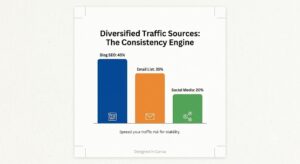
3. Never let one traffic source carry the whole business
Google can update its algorithm overnight. A social platform can throttle your reach without warning. A solo ad vendor can disappear. If 90% of your clicks come from one place, you don’t have a business, you have a rented audience.
Set a standing goal to test and grow a second and third traffic channel every quarter: pair organic content with paid traffic such as solo ads, or add a YouTube channel alongside your email funnel. The specific mix matters less than the habit of regularly adding a new source before you actually need one.
A useful test is, if your best-performing traffic channel vanished tomorrow, would the business survive on what’s left? If the honest answer is no, that’s your next quarter’s project, not a someday item.
4. Track the handful of numbers that actually move revenue
Open rate, click-through rate, and conversion rate by offer will tell you more in fifteen minutes than a week of guessing. The habit isn’t building a fancy dashboard, it’s a short, recurring review (weekly is enough) where you look at what drove sales, what didn’t, and adjust one variable at a time such as subject line, swipe copy, landing page, or offer.
Split-testing only works as a habit, not a one-off event, because a single test tells you what happened once, not what reliably happens. You don’t need enterprise software for this, the reporting built into your autoresponder, your affiliate network’s dashboard, and a free analytics tool cover almost everything a solo affiliate marketer needs to see the pattern.
5. Sell like a curator, not a pitchman
Pat Flynn, founder of Smart Passive Income and one of the most recognised voices in affiliate marketing, built his reputation and by his own account, more than $3.5 million in affiliate revenue since 2010 on a simple rule:
Only recommend what you’ve actually used and genuinely believe will help the person reading.
He describes the affiliate’s real job as playing “expert curator,” reducing the noise in a crowded market rather than adding to it.
That single filter, applied consistently before every promotion, is what keeps an audience opening your emails and clicking your links for years instead of unsubscribing after the third pitch.
Putting it into a week
Turned into an actual weekly checklist, the five habits look something like this:
- Content: one piece published, on the same day each week
- Email: three to seven sends to your list, mixing value with the occasional offer
- Traffic: one small action toward a second or third channel, even if it’s just research
- Metrics: a fifteen-minute review of opens, clicks, and conversions by offer
- Standards: a quick gut-check before any promotion — would you recommend this to a friend without being paid to?
The compounding effect
None of these five habits are complicated, and none of them will produce a windfall in week one.
That’s exactly the point. A blog post published every week, an email sent every day, a second traffic source tested every quarter, a fifteen-minute metrics review, and a hard rule about only promoting what you believe in.
Stacked over six or twelve months, these become the difference between an affiliate marketer who gets the occasional lucky commission and one who can predict, within a reasonable range, what next month’s income will look like.
Consistency doesn’t feel dramatic while you’re doing it. It just quietly turns into a business.